220-299Yehuda ben Yechezkel


Sayings of Yehuda ben Yechezkel extracted from the tractates Pesachim and Chullin (Babylonian Talmud). Babylonian Talmud was written between about 450 - 550 in present-day Iraq (formerly Babylonia). Religious scholar Yehuda ben Yechezkel points out the location of the ligamentum capitis femoris (LCF) in animals and distinguishes it from the sciatic nerve. See our commentary at the link: 220-299Yehudaben Yechezkel [Rus].

Quote 1.

[Heb]

Pesachim 83b10
(original source: sefaria.org)


Quote 2.

[Heb]

Chullin 91a2

(original source: sefaria.org)


Quote 3.

[Heb]

Chullin 93b9

(original source: sefaria.org)


Quote 4.

[Heb]

Chullin 93b11

(original source: sefaria.org)


Translation

Quote 1.

[Eng]

Passover Festivals 83b10

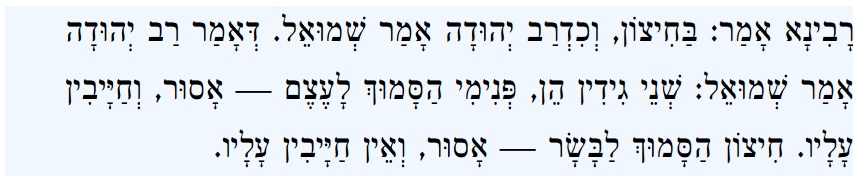
Ravina said: This discussion pertains to the outer nerve, and it is in accordance with that which Rav Yehuda said that Shmuel said, as Rav Yehuda said that Shmuel said: There are two sinews in the sciatic nerve: The inner sinew that is next to the bone is forbidden according to Torah law, and one is liable to be flogged for eating it. The outer sinew that is next to the meat is forbidden by rabbinic law, and therefore one is not liable to be flogged for eating it. Since the outer sinew is permitted according to Torah law, it attains the status of leftover when it is not eaten. (original source: sefaria.org)

Quote 2.

[Eng]

Chullin 91a2

Ravina said: The mishna’s statement is necessary only with regard to the outer nerve, and it is in accordance with that which Rav Yehuda said that Shmuel said. As Rav Yehuda said that Shmuel said: There are two nerves included in the prohibition of the sciatic nerve. The inner nerve that is next to the bone is forbidden by Torah law, and one is liable to be flogged for eating it. The outer nerve that is next to the flesh is forbidden by rabbinic law, and therefore one is not liable to be flogged for eating it. In the case of a Paschal offering, since the outer nerve is permitted by Torah law, it assumes the status of leftover sacrificial meat when it is not eaten. (original sourcesefaria.org)

Quote 3.

[Eng]

Chullin 93b9

§ The Gemara returns to the prohibition of eating the sciatic nerve. Rav Yehuda says that Shmuel says: There are two nerves included in the prohibition of the sciatic nerve. The inner nerve, which is next to the bone, is forbidden by Torah law, and one is liable to be flogged for eating it. The outer nerve, which is next to the flesh, is forbidden by rabbinic law, and therefore one is not liable to be flogged for eating it. (original source: sefaria.org)

Quote 4.

[Eng]

Chullin 93b11

The Gemara challenges: But isn’t it taught in a baraita: The outer nerve is next to the bone? The Gemara answers: Rav Yehuda said: This is referring to the spot where the butchers cut the leg open and reveal the nerve, and at that point in the leg the outer nerve is closest to the bone. (original source: sefaria.org)

External links

Babylonian Talmud. Pesachim (The William Davidson Edition). 450-550. [sefaria.org]

Babylonian Talmud. Chullin (The William Davidson Edition). 450-550. [sefaria.org]

Babylonian Talmud. Tract. Pesachim (Passover). Trans. M.L. Rodkinson Vol. 5. Boston: The Talmud Society, 1918. [archive.org]

Authors & Affiliations

Yehuda ben Yechezkel (ca. 220 – ca. 299) was a teacher (rabbi), lived in Pumbedita (Babylonia). [jewishencyclopedia.com , sefaria.org , wikipedia.org]

Keywords

ligamentum capitis femoris, ligamentum teres, ligament of head of femur, Bible, Torah, animals, anatomy, synonym


NB! Fair practice / use: copied for the purposes of criticism, review, comment, research and private study in accordance with Copyright Laws of the US: 17 U.S.C. §107; Copyright Law of the EU: Dir. 2001/29/EC, art.5/3a,d; Copyright Law of the RU: ГК РФ ст.1274/1.1-2,7

Comments

Popular posts from this blog

1816MeckelJF

    The author discusses the anatomy and function of the ligamentum capitis femoris (LCF), and also identifies one of the reasons for its damage. The translation was done in collaboration with ChatGPT 3.5.   Meckel JF. Handbuch der menschlichen Anatomie. Zweiter Band. Besondere Anatomie. Halle, Berlin: Buchhandlung des Hallischen Waisenhauses, 1816. [fragment] Quote p p . 3 65 -366 c. Runds band §. 948. Gerade vor dem Theile der Synovialhaut, welcher auf der Lücke unter dem brückenförmigen Theile der Knorpellippe liegt, entspringt ein, ungefähr einen Zoll langes, sehr länglichviereckiges Band, das runde Band des Oberschenkels (Ligamentum ossis femoris teres s. rotundum) welches, an beiden Enden etwas ausgebreitet, sich mit seis nem äußern an die Bertiefung im Kopfe des Oberschenkels beines heftet und zu noch größerer Befestigung deffelben beiträgt. Es besteht aus longitudinalen Fasern, welche sich an das obere un...

Australopithecus afarensis

  AUSTRALOPITHECUS AFARENSIS In 1735, Carl Linnaeus (1707-1778) placed humans as a species «Homo nosce te ipsum» in the order Anthropomorpha along with monkeys and sloths (1735LinneC). In a publication in 1758, the naturalist transferred humans to the order Primates (1758LinneC). Today, humans and chimpanzees are united in the tribe Hominini, as descended from a common ancestor (2001GrovesCP). It has been established that the chromosome that distinguishes humans from monkeys was formed before 4.5 Ma (2022PoszewieckaB_GambinA). The hominin subfamily Sahelanthropus tchadensis lived in the Republic of Chad (Central Africa) from 7.2±0.31 to 6.8±0.45 Ma (2008LebatardAE_BrunetM; 2012ReynoldsSC_GallagherA). Reconstruction of its musculoskeletal system showed that the creature could have been an upright bipedal primate (2005ZollikoferCP_BrunetM). Fossils of what is probably the first bipedal representative of the hominid family Orrorin tugenensis, lived 6.1-5.7 Ma and still retained adapta...

Human Children. Retelling of Chapter 5

  Short retelling of chapter 5 of the essay: Arkhipov S.V. Human Children: The Origins of Biblical Legends from a Physician's Perspective. Joensuu: Author's Edition, 2025. [In Russian]  Chapter 5.  ADAM AND EVE The Book of Genesis narrates the story of a tribe founded by Adam and Eve, described as the "mother of all living." From a genetic perspective, they are depicted as siblings, with an age difference of 18–25 years. According to the biblical epic, they formed humanity’s first family, sustaining themselves on pre-existing fruits and seeds. Their initial home was the "garden in Eden," located "in the east" relative to the narrator. The text identifies geographic markers for Eden’s location: lands like "Asshur," "Cush," and "Havilah," and rivers named "Pishon," "Gihon," "Hiddekel," and "Phrath." The narrator also notes the region’s economic value, mentioning "gold," ...

Great Compilation. Introduction

  English version of the article:  Архипов СВ. Книга Берешит как великая компиляция текстов и смыслов Второго переходного периода Египта: пилотная культурологическая, медицинская, археологическая и текстологическая экспертиза преданий против традиционной атрибуции. Введение.  О круглой связке бедра . 14.02.2026 .  The text in Russian is available at the following link:  2026АрхиповСВ .    The Book of Genesis as a Great Compilation of Texts and Meanings from the Second Intermediate Period of Egypt: A Pilot Culturological, Medical, Archaeological, and Textological Examination of the Legends versus Traditional Attribution . Introduction By Sergey V. Arkhipov, MD, PhD   CONTENT [i]   Abstract [ii]   Introduction [iii]   Content [iv]   External links [v]   Application [vi]   References [vii]   Application [i]   Abstract The Book of Genesis (Bereshith) was composed in Egypt during the 17th century BCE and reached ...

Tiktaalik roseae

  TIKTAALIK ROSEAE The first truly tetrapod animal (Limbed tetrapods) is recognized as the lobe-finned fish Tiktaalik roseae (clade Elpistostegalia), discovered in rocks aged about 375 Ma (2006DaeschlerEB_JenkinsJrFA; 2008ShubinN; 2017ShubinN). Discoveries in recent years have allowed us to place the taxa of early tetrapodomorphs in the following order: Tinirau, Eusthenopteron, Megalichthys, Panderichthys, Qikiqtania, Tiktaalik, Elpistostege, Parmastega, Ventastega, Acanthostega, Elginerpeton, Ymeria, Ichthyostega (2022StewartTA_ShubinNH). The closest ancestor of Tiktaalik roseae, the fragments of the skeleton of which are relatively well preserved, is Panderichthys. Reconstruction of the prehistoric fish Pandericthys Author Tyler Rhodes; original in the  wikipedia.org   collection (license CC BY-SA 3.0, no changes). The shape of the skeleton of the pectoral fin and shoulder girdle suggests that Panderichthys rhombolepis "walked" (2006AhlbergPE_ClackJA). At the very least...

Great Compilation. Chapter 38

  English version of the article:  Архипов СВ. Книга Берешит как великая компиляция текстов и смыслов Второго переходного периода Египта: пилотная культурологическая, медицинская, археологическая и текстологическая экспертиза преданий против традиционной атрибуции. Введение.  О круглой связке бедра . 14.02.2026 .  The text in Russian is available at the following link:  2026АрхиповСВ .    The Book of Genesis as a Great Compilation of Texts and Meanings from the Second Intermediate Period of Egypt: A Pilot Culturological, Medical, Archaeological, and Textological Examination of the Legends versus Traditional Attribution.  Chapter 38   By Sergey V. Arkhipov, MD, PhD   CONTENT [i]   Abstract [ii]   Book of Genesis. Chapter 38 Analysis [iii]   Notes to Chapter 38 [iv]   AI Agent's Conclusion [v]   Content [vi]   External links [vii]   Application [i]   Abstract The Book of Genesis (Bereshith) was compo...

Great Compilation. Chapter 1

     English version of the article:  Архипов СВ. Книга Берешит как великая компиляция текстов и смыслов Второго переходного периода Египта: пилотная культурологическая, медицинская, археологическая и текстологическая экспертиза преданий против традиционной атрибуции. Введение.  О круглой связке бедра . 14.02.2026 .  The text in Russian is available at the following link:  2026АрхиповСВ .    The Book of Genesis as a Great Compilation of Texts and Meanings from the Second Intermediate Period of Egypt: A Pilot Culturological, Medical, Archaeological, and Textological Examination of the Legends versus Traditional Attribution. Chapter 1 By Sergey V. Arkhipov, MD, PhD   CONTENT [i]   Abstract [ii]   Book of Genesis. Chapter 1 Analysis [iii]   Notes to Chapter 1 [iv]   AI Agent's Conclusion [v]   Content [vi]   External links [vii]   Application [i]   Abstract The Book of Genesis (Bereshith) was composed...

SURGERY

  SURGERY ( Osteotomy, arthroplasty, arthroscopy, ligamentoplasty... ) Inventions Method s  by Arkhipov S.V.   (subsection) Articles 1926HeyGrovesEH   The author proposes fixation of the femoral head by creating a LCF from the joint capsule during reduction of congenital hip dislocation.  1927HeyGrovesEH   The author  describes  fixation of the femoral head by creating a LCF from the joint capsule during reduction of congenital hip dislocation.  1968TrevorD  The author discusses E. Hey Groves's operation for reconstruction of the LCF in the reduction of congenital hip dislocation. 2021ArkhipovSV_SkvortsovDV   Ligamentum Teres and its Analog in the Hip Endoprosthesis–Necessary or Superfluous? A Systematic Review 2025ArkhipovSV. Why Acetabular Labrum Repair May Be Ineffective .  Article  (07.04.2025).  UNDERWATER  ROCK OF THE RECONSTRUCTIONS  What is the load on the  ligamentum capitis femoris ? The First...

Human Children. Retelling of Chapter 6

  Short retelling of chapter 6 of the essay: Arkhipov S.V. Human Children: The Origins of Biblical Legends from a Physician's Perspective. Joensuu: Author's Edition, 2025. [In Russian]  Chapter 6. THE GARDEN OF EDEN According to the Book of Genesis, humanity’s earliest ancestors emerged "in the garden of Eden." The text specifies that this idyllic garden was located "in Eden, toward the east." A nameless river flowed from Eden, irrigating the garden, suggesting that "Eden" encompasses a broader region, while the "garden in Eden" is a distinct, cultivated space. Genesis portrays the garden as a divine plantation, established by "Lord God," with humans tasked to tend and maintain it. The garden teemed with diverse trees, including fruit-bearing ones, and later hosted birds, wild animals, and domesticated livestock. Alongside humans, it harbored supernatural beings like cherubim (kyruvy), a serpent, and other divine entities. A s...

Great Compilation. Chapter 48

  English version of the article:  Архипов СВ. Книга Берешит как великая компиляция текстов и смыслов Второго переходного периода Египта: пилотная культурологическая, медицинская, археологическая и текстологическая экспертиза преданий против традиционной атрибуции. Введение.  О круглой связке бедра . 14.02.2026 .  The text in Russian is available at the following link:  2026АрхиповСВ .    The Book of Genesis as a Great Compilation of Texts and Meanings from the Second Intermediate Period of Egypt: A Pilot Culturological, Medical, Archaeological, and Textological Examination of the Legends versus Traditional Attribution.  Chapter 48   By Sergey V. Arkhipov, MD, PhD   CONTENT [i]   Abstract [ii]   Book of Genesis. Chapter 48 Analysis [iii]   Notes to Chapter 48 [iv]   AI Agent's Conclusion [v]   Content [vi]   External links [vii]   Application [i]   Abstract The Book of Genesis (Bereshith) was compo...