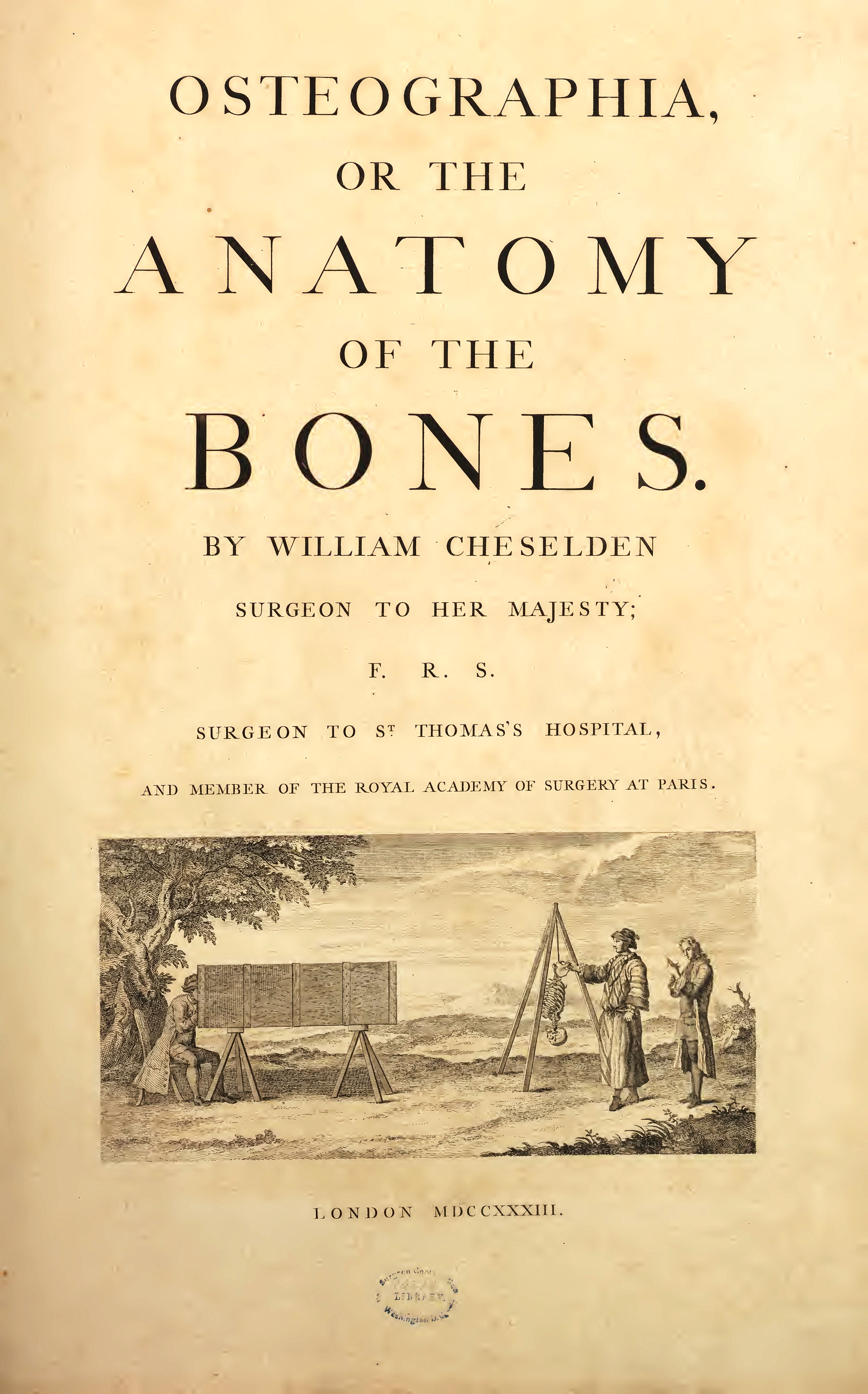
1733CheseldenW


Fragments from the book Cheselden W. Osteographia, or the anatomy of the bones (1733). The author describes the anatomy, function and topography of the ligamentum capitis femoris (LCF). The work indicates the size of the LCF – about 1 inch (25.4 mm) and two synonyms: “teres” and “rotundum”. 

Quote 1.

CHAPTER VI. CARTILAGES, LIGAMENTS, & c.

…From the lower edge of the acetabulum or socket of the os innominatum arises a ligament about an inch long called teres, or rotundum, (Tab. xxxix.) which length is necessary for that quantity of motion which this joint has in human bodies; it also hinders the os femoris from dislocating upwards, but downwards it will fusser it to go far out of the socket; but in brutes the head of the os femoris being oblong, and the cavity suitable, there can be only a rotatory motion, which in the effect will be very little more than that kind of motion which is called bending and extending; and this never removing the end of the head of the bone far in the socket, a short ligament is enough for it, and will better keep the bone in its place; and therefore it is that theirs is so short. This ligament in men may also serve to press the gland in the bottom of the acetabulum or socket. …

… These glands are generally seated in a little fat near the insertion of the ligaments, that they may be compressed by them when the joints are in motion; which is a proper time to have their fluid pressed out. The most considerable parcel of these glands with their fat, are feen in the joint of the knee, and the largest gland of this sort is found in the sinus at the bottom of the acetabulum of the os innominatum, and is compressed by the ligamentum teres.


Quote 2.

TABLE XVIII. FIG. I. The outward view of the ossa innominata.

D   A sinus in the acetabulum, in which is lodged the lubricating gland of this joint, and in which the ligamentum teres lies secure from being hurt by the motion of the os femoris.


Quote 3.

TABLE XXXIX. FIG. II.

C   The ligamentum teres which hinders the os femoris from being luxated upwards.


External links

Cheselden W. Osteographia, or the anatomy of the bones. London: W. Bowyer [?], 1733. [ archive.org , collections.nlm.nih.gov]

Authors & Affiliations

William Cheselden (1688-1752) was an English surgeon and teacher of anatomy and surgery. [wikipedia.org]


William Cheselden (18th century
Author: Jonathan Richardson, engraved possibly by Ambroise Tardieu; 
original in the 
wikimedia.org collection (CC0 – Public Domain, no changes)

Also see the portrait at the link: royalacademy.org.uk & artuk.org

Gerard van der Gucht and Mr. Shinevoet – engravers of book. [nlm.nih.gov]

Keywords

ligamentum capitis femoris, ligamentum teres, ligament of head of femur, anatomy, role, synonym

                                                                     .

NB! Fair practice / use: copied for the purposes of criticism, review, comment, research and private study in accordance with Copyright Laws of the US: 17 U.S.C. §107; Copyright Law of the EU: Dir. 2001/29/EC, art.5/3a,d; Copyright Law of the RU: ГК РФ ст.1274/1.1-2,7

ROLE AND SIGNIFICANCE

Comments

Popular posts from this blog

University_of_Guelph(website)

  Content [i]   Annotation [ii]   Original text [iii]   Illustrations [iv]   Source  &  links [v]   Notes [vi]   Authors & Affiliations [vii]   Keywords [i]   Annotation A quote from an article on the University of Guelph website. The publication mentions the animal's ligamentum capitis femoris (LCF) and states its function: fixing the femoral head in the acetabulum. The text in Russian is available at the following link: University_of_Guelph(website) . [ii]   Original text Quote 1.  Hindlimb skeleton. Femur [animals]   The articular head of the femur is deeply rounded and it bears a round ligament that holds it into the acetabulum.   [iii]   Illustrations – [iv]   Source  &  links STRUCTURE OF THE SKELETON.  2023.   animalbiosciences.uoguelph.ca [v]   Notes The work  is cited in the following publications:  [vi]   Authors & Affiliations Unive...

Tweet of December 19, 2025

  Edwin Smith Papyrus vis-à-vis Book of Genesis   A correspondence was found between the level of medical knowledge in the Edwin Smith Papyrus and the Book of Genesis; they were written during the same historical period. see: https://kruglayasvyazka.blogspot.com/2025/11/lcf-1.html Tweet of December 19, 2025 #Edwin_Smith_Papyrus  #Genesis  #Book_of_Genesis #Ancient_Egypt BLOG CONTENT TWITTER OR X                                                                            

Edwin Smith Papyrus vis-à-vis Book of Genesis

   A correspondence has been found between the level of medical knowledge in the Edwin Smith Papyrus and the Book of Genesis. Were both works written during the same historical period? What do medical historians and Egyptologists think about this?  Based on the analysis I conducted, I believe that the protograph of the Book of Genesis was written at the end of the Second Intermediate Period in Egypt, with the collaboration of an Asian diviner and an Egyptian physician. Arguments in more detail are presented in my online article: Архипов С . В . Кто и когда впервые описал повреждение ligamentum capitis femoris ? (WHO FIRST DESCRIBED THE LIGAMENTUM CAPITIS FEMORIS INJURY AND WHEN? This article is available in Russian, and translation to your desired language can be done using a browser plugin). See: Pt. 1. https://kruglayasvyazka.blogspot.com/2025/11/lcf-1.html Pt. 2. https://kruglayasvyazka.blogspot.com/2025/11/lcf-2.html Pt. 3. https://kruglayasvyazka.blogspot.com/2...

Key Role of the LCF

  In the experiments conducted on the pelvis-femur-muscle-ligaments model, we found that when the contralateral pelvic drop occurs, the ligament of the head of femur become maximally tense; simultaneously, there is relaxation and lengthening of the gluteus medius muscle; the pelvis spontaneously rotates towards the stance limb (forward), and the load on the hip joint decreases. Thanks to the functioning of the ligament of the head of femur the walking is smooth, rhythmic, and energy-efficient. Track Music:  Blue Dot Sessions , Vittoro (CC BY-NC 4.0 DEED / fragment)  "Take care of the ligament of the head of femur for yourself and your neighbor!" .                                                                       . keywords: ligamentum capitis femoris, ligament of head of femur, ligamentum te...

ZOOLOGY AND PALEONTOLOGY

  ZOOLOGY AND PALEONTOLOGY   (Information on the presence in existing and extinct animals... ) LCF of Pithecanthropus   In the hip joint of Pithecanthropus (Pithecanthropus erectus, Homo erectus 2.12-0.43 Ma), there was a LCF. LCF of Australopithecus   The Australopithecus afarensis (3.2 Ma) had a ligament of the  head of femur.  1802CamperP  The author discusses the absence and unknown role of the LCF in the elephant and some monkeys. 1803CamperP  The author discusses the absence and unknown role of LCF in the orangutan, elephant, and sloth.  1824MeckelJF   The author notes the absence of LCF in orangutans, three-toed sloths and turtles.  1835OwenR  The author discusses the absence of the LCF in chimpanzees, orangutans and some other mammals. 1851BarkowHCL   The author briefly describes LCF in the tiger and llama.  1864MacalisterA  LCF has been observed in ostrich and is noted to be strength.  1869MivartG ...